

Every January, the same motivation wave hits. People swear that this is the year they finally commit to their health. Gym memberships spike overnight, parking becomes a nightmare, and suddenly every treadmill has a wait time. Two weeks later, attendance plummets. By February, the resolution glow fades. By March, most people are right back where they started—until next year.
But here’s the thing: failure doesn’t happen because people don’t care. It happens because they mistake motivation for infrastructure. Wanting change isn’t enough. You need a system that holds you accountable when inspiration disappears. That’s why more people are quietly replacing crowded gyms with something far more powerful: a personal strength ecosystem at home.
At-home training replaces gym crowds not because it’s trendy, but because it actually works when life gets loud. And in 2026, choosing a home gym isn’t about grabbing whatever claims to be “all-in-one.” It’s about investing in something resolution-proof—a machine that outlasts fads, frustration, and fluctuating motivation.
If you’re serious about knowing how to choose a home gym machine in 2026, this guide will walk you through the exact criteria that matter most so you don’t end up with an expensive coat rack masquerading as “fitness equipment.”
The Resolution Mindset Needs a Better Strategy
Most fitness goals fail because they are built on emotion instead of engineering. People set intentions without installing the structure required to support them. When your plan depends on driving to a gym after a long day, hoping a machine is available, and competing with twenty other people for space, your system is fragile from the start.
When you shift your environment, you change your behavior. At-home training replaces gym crowds because it removes the friction that kills consistency. No commute. No waiting. No awkward stares. No excuses.
And that’s where mindset turns into commitment.
When you install a real home gym in your own space, you don’t need a spark of motivation to train—you just need to walk into the room. Ownership changes psychology. Your gym stops being a place you go and becomes part of your daily environment. That’s what makes transformation sustainable.
This is the moment people stop starting fitness—and start installing it.
Resistance Types: The Foundation of Any Home Gym
If you want to understand how to choose a home gym machine, you need to start with resistance types. The quality, feel, and flexibility of resistance will determine not only how effective your training is—but whether you actually enjoy doing it.
Weight stacks have long been the gold standard for home and commercial gyms because of their consistency and safety. They provide smooth tension across the entire range of motion without requiring you to balance plates or stabilize heavy loads in unsafe positions. This makes weight stacks ideal for both beginners and experienced lifters who want efficient, targeted training without unnecessary risk.
Plates, on the other hand, often appeal to those who want a more traditional feel. The problem is that plate-loaded systems require more space, more handling, more setup, and a higher risk of improper loading. They are more physically demanding before you even start exercising.
Then there are resistance bands and digital resistance systems, which promise innovation but often lack realism. Bands lose tension at certain parts of the movement. Digital resistance lacks the feel and feedback of real load. These systems can be useful as accessories—but as a foundation, they frequently fall short for serious training.
The key isn’t just resistance—it’s reliability. If your gym doesn’t feel natural, doesn’t load consistently, or doesn’t allow progression with confidence, your results will stall.
The best systems don’t ask you to adapt to them.
They adapt to you.
Footprint vs Functionality: Bigger Isn’t Always Better
One of the most misunderstood aspects of buying a home gym is size. Many people assume that larger means more powerful and smaller means compromised. In reality, a smart footprint is about efficiency, not bulk.
A bloated system that takes over your garage but doesn’t let you train your entire body smoothly isn’t impressive—it’s impractical.
Modern home gyms are engineered to compress functionality into smarter layouts. Multi-axis cable systems, adjustable arms, integrated leg options, and dual-function attachments allow high-volume training without owning a warehouse.
This is exactly where Legion reframes expectations.
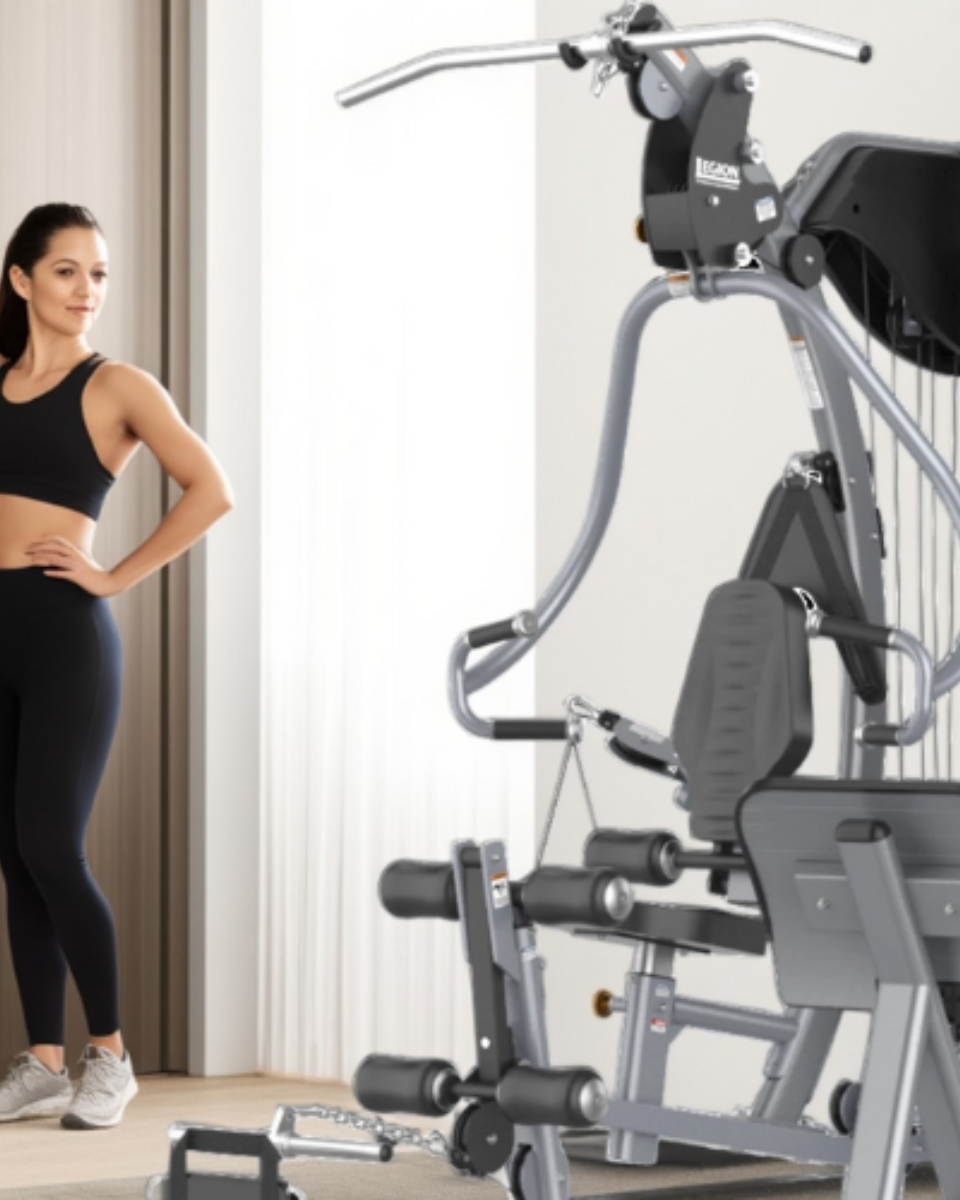
The Legion Fitness Equipment line of machines is designed with this principle in mind: build more capability into less chaos. The G7 and G9 platforms are engineered to give you every movement pattern you need without spreading your gym across multiple machines.
A serious home gym should not monopolize your space.
It should maximize it.
That’s one of the defining differences between novelty equipment and professional design.
Expandability: Because Your Strength Will Outgrow Your First Setup
If your gym isn’t expandable, it’s already obsolete.
One of the biggest mistakes people make when figuring out how to choose a home gym machine is focusing only on where they are today, not where they’ll be in six months.
Beginners don’t train like intermediates.
Intermediates don’t train like advanced lifters.
And your machine must scale with you.
A serious system doesn’t lock you into static capability. It allows you to add attachments, upgrade resistance, swap accessories, and evolve your training style. Whether you shift into athletic performance goals, rehabilitation, hypertrophy, or endurance strength, your equipment must grow alongside you.
What begins as basic push-pull sessions eventually becomes:
More volume.
More load.
More intensity.
More precision.
Legion designs its systems with long-term progression in mind. Expandable platforms ensure users don’t “outgrow” their investment after their first year of progress.
And here’s the truth:
When people outgrow equipment, they abandon it.
A resolution-proof home gym grows as you do.
Why “All-in-One” Doesn’t Mean “One-Size-Fits-All”
“All-in-one” is one of the most abused phrases in fitness marketing.
Most of the time, it means the equipment tries to do everything… and masters nothing.
True all-in-one systems aren’t about stacking features—they’re about integrating function. There’s a massive difference between a machine with “100 exercises” listed on the box and one engineered for meaningful mechanical advantage at every movement.
The best designs account for:
Range of motion
Force curves
Joint safety
Load direction
User height differences
Grip variation
Postural integrity
This is where engineering beats advertising.
A good system feels like it disappears when you play within it. You don’t fight the machine—it cooperates with you. Everything moves where it should. Everything loads correctly. Everything supports your motion instead of steering it awkwardly.
“All-in-one” only matters if every movement actually works.
Where G7 and G9 Win by Design
The difference between a consumer gadget and professional equipment becomes obvious within the first ten workouts.
The Legion G7 and G9 were not built to impress in a showroom.
They were built to perform under repetition.
The Legion G7 brings together smooth cable systems, adjustable stations, and ergonomic precision to produce full-body training with minimal exposure to poor form.
The Legion G9 extends capability for serious users who want multi-user space, advanced attachment options, and heavier loading potential.
These systems aren’t just machines.
They’re frameworks for progression.
They assume your strength will increase.
They expect your training to evolve.
They’re designed to support growth—physically and psychologically.
That’s what makes them resolution-proof.
Machines vs Random Workouts: Why Structure Wins
If you ask ten people how to train, you’ll get ten different answers.
That’s not flexibility—that’s chaos.
What stops results in most cases isn’t laziness.
It’s confusion.
Random workouts feel absorbing in the moment but rarely build anything sustainable. Structure beats enthusiasm every time.
Machines create rails for progress:
They define movement.
They regulate load.
They ensure safety.
They improve repeatability.
Random workouts tire you.
Structured training transforms you.
When you install a serious home gym, you install rules. Rules create standards. Standards create results.
This is exactly why at-home training replaces gym crowds for people who actually care about long-term change.
This Is Not A Phase. It’s a System.
People who quit talk about “getting back into it.”
People who win talk about “staying consistent.”
The language tells the story.
When fitness becomes an identity rather than an activity, everything changes. Your calendar adjusts. Your priorities shift. Your standards rise.
Buying a world-class home gym isn’t indulgent.
It’s infrastructure.
You don’t build a business without software.
You don’t build a house without plumbing.
You don’t build a body without equipment that makes no excuses.
When your environment supports your goals, willpower becomes optional.
And when willpower stops being the gatekeeper, results stop being fragile.
2026 Is Not the Year to Gamble on Your Body
Trends will come and go.
Fads will rise and burn out.
Social media workouts will endlessly recycle.
Your body, however, will age in one direction.
If you’re ready to stop experimenting and start executing, the decision becomes simple. You don’t build your future strength on guesswork.
You build it on systems.
You build it on standards.
You build it on equipment that refuses to become irrelevant.
Learning how to choose a home gym machine isn’t about finding the cheapest deal.
It’s about eliminating your future excuses.
Make your setup stronger than your weakest day.
Make your equipment louder than your doubt.
Make your environment unstoppable.
Build Once. Train Forever.
Your resolution doesn’t need hype.
It needs hardware.
If you’re tired of:
Crowded gyms
Stalled results
Program hopping
Motivation crashes
Short-lived goals
Then it’s time to stop treating fitness like a seasonal hobby and start treating it like an operating system.
This isn’t about buying a machine.
It’s about installing discipline.
This isn’t about New Year.
It’s about next decade.
At-home training replaces gym crowds.
Systems replace motivation.
Professionals replace amateurs.
And the right home gym replaces regret.
Build your system now.
Your future body is already waiting.
Share:
New Year, No Excuses: Build a Real Strength Routine at Home with the Legion G7
Why February Quitters Succeed with Better Equipment (Not More Motivation)