

There’s a moment in everyone’s life when fitness stops being about appearance and starts becoming something deeper. It stops being about chasing a version of yourself you saw online, and starts becoming about reconnecting with the version of you that feels grounded, capable, and steady.
That shift is where real change begins.
Self-love is often misunderstood as softness or indulgence, but in reality, self-love is structure. It is boundaries. It is showing up for yourself when it would be easier not to. And for many people, it is discovered through training—specifically through consistent, intentional strength work at home.
This is where strength training for confidence becomes more than a phrase. It becomes a practice. A daily decision to build not just muscle, but identity.
With the right environment and the right equipment, training becomes more than physical exercise. It becomes emotional regulation, stress relief, and a powerful tool for self-trust. That is exactly the role modern home gym systems—like those designed by Legion Fitness Equipment—are beginning to play in people’s lives.
This is not just about lifting weights. It is about lifting yourself.
Self-Love Isn’t Passive—It’s Built Through Action
Many people think self-love is something you feel. In reality, it is something you practice.
It shows up when you choose to move your body even after a long day. It shows up when you prioritize your health instead of ignoring it. It shows up when you decide that your energy, your strength, and your future matter enough to invest in.
Training is one of the most honest expressions of self-respect because it requires effort. It requires consistency. And it requires you to keep promises to yourself, even when no one is watching.
This is why strength training for confidence is so powerful. It is not about perfection—it is about repetition. Each session becomes a small act of self-trust that compounds over time.
At-home training makes this even more personal. Without the noise of crowded gyms or external pressure, your workouts become a private agreement between you and yourself. That privacy often becomes the safest place for real transformation to begin.
Strength Training as Emotional Regulation
Modern science continues to reinforce what many people discover through experience: strength training is one of the most effective tools for emotional regulation.
Resistance training has been shown to reduce symptoms of anxiety and depression, improve mood stability, and increase overall psychological resilience. One reason is its effect on neurotransmitters like dopamine and serotonin, which play a key role in mood regulation and motivation. Another reason is the immediate feedback loop it creates—effort produces measurable progress, which reinforces a sense of control.
When life feels unpredictable, lifting weights creates structure. When stress builds, physical effort provides release. When emotions feel overwhelming, training gives them somewhere to go.
This is why many people describe strength training as a form of therapy. Not because it replaces mental health care, but because it supports emotional processing through physical action.
With home training systems, this becomes even more accessible. You do not need to schedule a class or commute to a gym. You simply step into your space and move.
Over time, that consistency builds stability. And stability builds confidence.
Boundary-Building Through Training
One of the most overlooked benefits of home strength training is its ability to reinforce personal boundaries.
Boundaries are not just emotional concepts—they are behavioral patterns. They are what you choose to protect and prioritize in your daily life.
When you commit to training at home, you are making a clear statement: your time matters. Your health matters. Your needs are not optional.
This becomes especially powerful in busy households, relationships, or demanding work environments. Training time becomes protected time. It is not something that gets constantly rescheduled or interrupted. It becomes part of your identity structure.
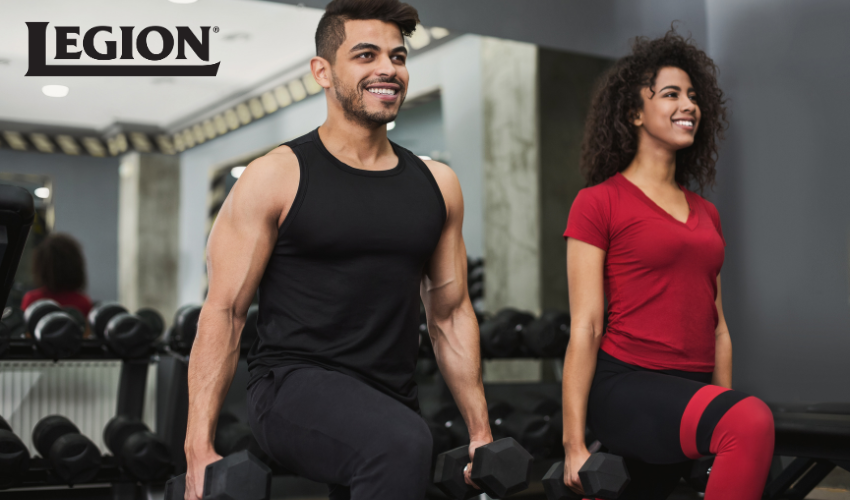
For couples, this can be even more meaningful. Shared couples training routines can transform workouts into mutual support systems rather than competing priorities. When both partners respect the training window, it becomes a shared form of discipline rather than a sacrifice.
Legion’s home systems support this dynamic by making training accessible in shared environments. Instead of navigating crowded gyms or conflicting schedules, couples can train together or side by side, reinforcing both personal and relational boundaries.
Boundaries, in this sense, are not walls—they are foundations.
Body Trust: Rebuilding the Relationship with Yourself
Many people struggle not with their bodies, but with their relationship to their bodies.
Years of inconsistency, stress, or negative self-perception can lead to a disconnect where the body feels unpredictable or unfamiliar. Strength training helps rebuild that relationship through predictable feedback.
When you train consistently, your body responds in clear, measurable ways. You get stronger. You move better. You recover faster. Over time, this creates trust.
You begin to understand that your body is not working against you—it is responding to you.
This is where strength training for confidence becomes transformative. Confidence is not built through appearance alone. It is built through experience. Through knowing what your body can do, not just how it looks.
At-home training reinforces this because it removes comparison. There are no distractions, no crowded mirrors, no external benchmarks. Just you, your effort, and your progress.
That simplicity is powerful. It allows you to rebuild trust without interference.
Identity Formation Through Strength Training
Identity is not something you discover—it is something you build through repeated behavior.
When you consistently show up for strength training, you begin to see yourself differently. You are no longer someone who “tries to work out.” You become someone who trains.
That shift may seem small, but it is psychologically significant. Identity-based habits are far more stable than motivation-based habits because they are tied to self-perception rather than emotional state.
Each workout reinforces a new identity layer:
- I am someone who shows up.
- I am someone who takes care of my body.
- I am someone who builds strength instead of avoiding effort.
Over time, these repeated actions form a stable identity rooted in discipline rather than aesthetics.
This is where discipline over aesthetics becomes essential. When training is only about appearance, it becomes fragile. When training is about identity, it becomes permanent.
Why Home Training Deepens the Self-Care Experience
Self-care is often marketed as relaxation—bath bombs, rest days, or temporary escape. While rest is important, true self-care also includes effortful care.
Strength training is active self-care. It is the decision to invest energy now for long-term well-being.
Training at home enhances this experience because it removes external pressure. You are not performing for anyone. You are not competing for space or attention. You are simply taking care of yourself in a direct, uninterrupted way.
Legion home systems make this accessible by removing logistical barriers. When equipment is available at home, self-care becomes integrated into daily life rather than scheduled around it.
This consistency is what turns training from a task into a ritual.
Science-Backed Benefits of Strength Training for Confidence
Research consistently supports the psychological benefits of resistance training. Studies have shown that regular strength training improves self-esteem, reduces anxiety, and enhances cognitive function.
One major reason is the improvement in self-efficacy—the belief in one’s ability to succeed in specific tasks. As individuals progress in strength training, they repeatedly achieve small, measurable goals. These wins accumulate and reinforce confidence in other areas of life as well.
Additionally, resistance training has been linked to improved stress resilience. The physiological stress of lifting weights teaches the body to adapt and recover, which can translate to improved emotional regulation under real-world stress.
In simpler terms: training your body helps train your mind.
Legion Equipment as a Foundation for Confidence
Legion Fitness Equipment is designed around consistency, progression, and usability—three key factors that support long-term adherence.
Machines that are intuitive, stable, and versatile reduce friction in the training process. When setup is simple and movement is controlled, users are more likely to maintain consistency.
This is especially important for home training, where motivation must compete with daily responsibilities. Equipment that is easy to use becomes a bridge between intention and action.
Whether used for solo training or couples training, Legion systems create structure that supports habit formation rather than complexity that disrupts it.
Couples Training and Shared Self-Care
When couples train together, something interesting happens: accountability becomes relational rather than internal.
Instead of relying solely on personal motivation, partners support each other through consistency. This shared commitment strengthens both the habit and the relationship.
Couples training also reinforces emotional connection. Shared physical effort can increase communication, trust, and mutual understanding. It transforms training from an individual task into a shared ritual of care.
In this context, self-care is no longer isolated. It becomes shared growth.
Strength Is the Language of Self-Love
Self-love is not passive. It is not occasional. It is not dependent on how you feel in the moment.
Self-love is consistent action taken in your own best interest.
Strength training is one of the most direct ways to practice it. It builds confidence through effort. It builds identity through repetition. It builds resilience through challenge.
And when done at home, it becomes even more personal, more sustainable, and more integrated into daily life.
This is what strength training for confidence truly means. Not perfection. Not aesthetics. But the steady construction of a stronger, more grounded version of yourself.
With the right system, the right environment, and the right equipment, that version is not far away.
It is built—rep by rep, day by day, at home.
Share:
The Truth About ‘Summer Bodies’: Build Muscle Year-Round
Why Lifting Beats Cardio for Fat Loss (And How to Start at Home)